

Something is already happening inside your company. Quietly, without a formal project kickoff or an IT ticket, your employees are building software.
A finance analyst built a reporting tool over a weekend. An operations manager wrote a script to clean up a persistent data problem. A compliance officer put together a first draft of an internal knowledge assistant. None of them would call themselves developers. But all of them used AI and all of them now have working code running somewhere in your business.
This is not a future scenario. It is the present reality for most mid-sized companies. And the organizations that get ahead of it — rather than simply react to it — will have a significant advantage.
What AI Has Changed
To bridge the gap between what your employees are building and what your business can safely operate, you need a specific kind of capability. Call it Internal Software Enablement, or AI Code Hardening. The name matters less than the function.
The person or team filling this role sits close to the business, not buried inside IT. They work directly with the people building things: finance, operations, compliance, sales, HR. They help those teams understand what is safe to ship and what needs more work. And they help IT understand what it is now being asked to support.
In practice, this looks like establishing lightweight internal standards:
- Where prototypes are stored and how code is reviewed before it goes into use
- What data can and cannot be accessed by internally built tools
- How credentials and secrets are managed
- When legal or compliance review is required
- What qualifies as a safe one-off script versus a tool that needs to be built properly
- What can be automated safely and what requires a human in the loop
- Should an instruction guide be developed alongside the solution, enabling users other than the original author to be able to use the application successfully?
This is not just software governance. It is operational risk management. It is the difference between a company that benefits from AI-assisted development and one that accumulates quiet technical debt or worse, a quiet compliance exposure.
The Talent Question
Many business leaders assume that finding this kind of expertise requires recruiting from large technology companies or paying Silicon Valley-caliber salaries. That assumption is increasingly outdated.
The skills involved — code review, system design, deployment discipline, security awareness, documentation, and the judgment to know when something is ready to be trusted — exist in experienced software engineers everywhere. And as AI changes what large tech companies need from their own engineering teams, more of this talent is available outside traditional tech hubs than at any point in recent memory.
The right person to help your organization navigate this challenge may already be in your market. They may be an experienced engineer looking for work that is closer to a real business. They may be a consultant or advisory firm that has already worked through these patterns with other mid-sized companies.
You do not need to become a technology company to manage this well. You need people with the right judgment and a clear mandate to use it.
What Leaders Should Do Now
You do not need to wait until this becomes a problem to act. A few principles that tend to work:
- Take inventory. Find out what employees have already built. You may be surprised by the scope and variety. This is not an audit to shut things down, it is reconnaissance.
- Create a safe channel. If employees feel they will be penalized for building, they will build in secret and you will lose visibility entirely. A lightweight approval or disclosure process is far better than prohibition.
- Establish ownership. Every internally built tool should have a named owner, a documented purpose, and a known home. Ownership creates accountability.
- Define the tiers. Not every tool needs to be production-grade. But your teams should have a shared vocabulary for what tier a given tool falls into and what that means for how it is managed.
- Get the right help. Whether through a hire, a structured engagement with an outside advisor, or an internal center of excellence, you need someone with software engineering judgment who can evaluate what has been built and help it mature responsibly.
The Bigger Opportunity
There is a version of this story that ends badly: unchecked growth of fragile internal tools, a quiet compliance exposure, a business-critical script that breaks and no one knows how to fix it.
But there is a much better version. It is the version where employee-led development becomes a genuine competitive advantage — where the people who understand your business best are also empowered to improve it, and where the right structures are in place to make their contributions reliable.
AI has given your employees a remarkable new capability. The question is not whether to allow it. The question is whether you are ready to lead it.
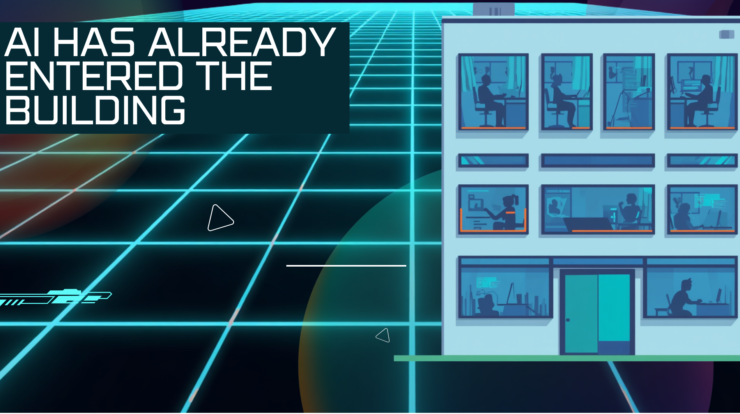
The companies that win in this next phase will not be the ones that waited for their technology department to figure this out. They will be the ones where leadership recognized that AI had already entered the building and decided to channel it, rather than simply chase it.
Final Thought
The anxiety about AI replacing workers is real. But inside most mid-sized companies, the more immediate challenge is almost the opposite: employees who are using AI to create things, faster than the organization knows how to manage.
That is a solvable problem. It requires judgment more than technology. It requires people who can sit at the intersection of business intent and technical discipline, and help your organization build a new kind of muscle.
The organizations that develop that muscle now will be significantly better positioned than those that are still figuring it out when the tools become even more powerful.
About the Author
Katrina Montinola is the AI Practice Lead Partner at 2Go Advisory Group, where she works with mid-sized companies on the practical side of AI adoption: helping leadership teams build the structures, judgment, and operating models that turn employee-driven experimentation into reliable business value.
Her clients span industries as varied as distribution, specialty testing, and nonprofit services — organizations with strong operators and deep domain expertise that are navigating what AI makes possible in their specific businesses.
If you are starting to recognize the dynamics described in this article, or suspect you already have more going on than you have visibility into, she is available for an initial conversation.

Reach Katrina at kmontinola@cios2go.com or +1 (650) 346-3880. Learn more at https://www.2goadvisorygroup.com/artificial-intelligence.
For your Talent needs in direct hire, full-time or part-time contract staffing, contact Executive Recruiter, Leesa Meintzer at leesa@2gorecruiting.com.

Leesa Meintzer is an executive recruiter with more than 20 years of experience in talent acquisition. She excels in partnering across various business functions and brings a comprehensive perspective to talent acquisition. She works with Engineering, Healthcare, Product, Finance, Accounting, Business Operations, Sales, Manufacturing, Human Resources, Learning & Development, and Talent Acquisition for corporate and high-growth start-ups.