

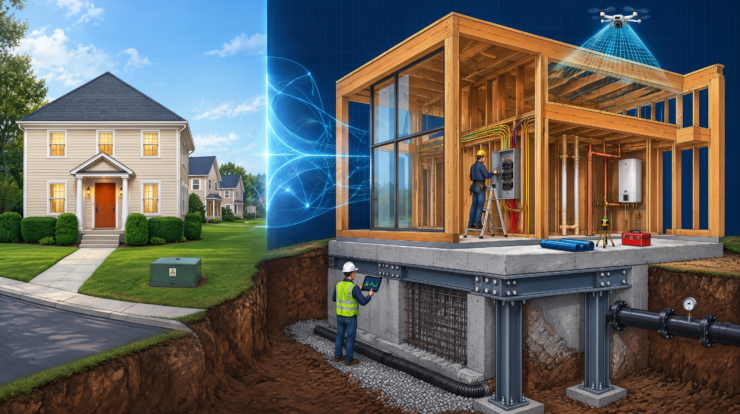
Most of us live in houses someone else designed. A tract home is built for the broadest possible buyer: a formal dining room you use twice a year, a bonus room that becomes storage, a kitchen laid out for an average family that isn’t quite yours. A custom home, by contrast, has exactly the rooms you want, where you want them. For most of history the difference came down to cost, and the cost was in the building.
Now imagine a crew that could frame your custom home in a weekend for a fraction of the usual price. That would change the math overnight. But anyone who has built a house knows the framing is the visible part. Before anyone moves in, the wiring, plumbing and foundation have to pass inspection, and once they do, someone has to maintain the house for decades. The structure goes up quickly. Making it safe to live in, and keeping it that way, is the real work.
That distinction sits at the heart of the oldest question in enterprise technology, build or buy, and AI has just changed the economics of it in a way most business leaders have not fully absorbed.
The pendulum has swung toward build
For most of my career, the answer for a non-software company was almost always “buy.” Custom software meant hiring developers, writing specifications, waiting months for a first version and then funding a team indefinitely to keep it running. Unless the capability was a genuine competitive differentiator, the math rarely worked.
Vibe coding, describing what you want in plain language and letting an AI coding assistant write the software, has collapsed the cost of that first version. A business analyst or an operations manager can now produce a working internal tool in days, sometimes hours. Prototypes that once required a development team and a budget cycle can be built on a Tuesday afternoon and demoed on Wednesday. The barrier to building has dropped so far that I now see companies seriously considering custom solutions for problems they would never have considered building for even two years ago.
Even the largest software vendors see it coming. At Dreamforce in September, Marc Benioff dismissed talk of a “SaaSpocalypse” as nonsense. Yet the centerpiece of his keynote was AIforce, which Salesforce says lets anyone build their own UI rather than navigating its standard screens. That is a telling move. Salesforce is acknowledging that customers want software shaped to the way they actually work, and it wants to get in front of that trend: to be the platform people build on, not the product they build around.
I think that shift is real and, in many cases, healthy. But the cost of the first version was never the whole cost.
The hidden cost of buying
The case for building is stronger than it first appears, because the case for buying carries a cost we rarely put on the spreadsheet. Commercial software is designed for a broad market. To win thousands of customers, a vendor has to serve thousands of slightly different ways of working, and every one of those accommodations becomes a feature, a setting, a menu or a module.
Your company pays for all of it. You pay in license fees that fund features you will never use. You pay in implementation projects spent configuring a general-purpose tool to behave like your specific process. And you pay, quietly and continuously, in the time your people spend learning to navigate screens that were designed for someone else’s workflow. Ask any team using a large CRM or ERP how much of it they actually touch, and the answer is usually a small fraction.
A vibe-coded tool built for one team’s real process can be startlingly lean by comparison: the five screens they need, the fields they actually fill in, the report their manager actually reads. That fit is a genuine advantage, and for the right problem it can outweigh everything a vendor offers.
The catch: who makes it production-grade?
This is the inspection that comes after the framing. A vibe-coded application that works in a demo is not the same as software you can run your business on. Production software has to handle bad data and unexpected inputs. It has to be secure, with proper authentication, access controls and protection of sensitive information. It needs backups, monitoring and a plan for when something breaks at 2 a.m. It needs to be tested when the underlying AI models, libraries or business rules change. And someone has to understand the code well enough to fix it, even if no human wrote most of it.
This hardening work is where I believe many non-software companies will stumble. Their IT teams are often excellent, but they are typically organized around deploying, integrating and supporting software that vendors built, tested and patched. When a vendor ships an update, the vendor owns the quality. When your own team vibe-codes a tool, your company owns the quality, the security and every future fix. That is a different job, requiring different skills: code review, testing discipline, secure deployment and lifecycle management. Many IT organizations have never been asked to do it.
The risk is not that vibe-coded software fails dramatically on day one. It is that a useful prototype quietly becomes a critical system, a house people are living in that never passed inspection, with no one accountable for maintaining it as the business changes around it.
Even a build you throw away has value
Recently, a client leader spent a weekend vibe-coding a tool for a problem his team had been wrestling with. On Monday he sat in a vendor demo for a product that did much the same thing, and he wondered aloud whether he had wasted his weekend. I don’t think he did. Building it forced him to work through every requirement, edge case and trade-off himself. He walked into that demo knowing exactly what to ask, which features mattered and which were just polish.
Vendors are skilled at demonstrating their strengths; a buyer who has built a rough version knows where to look for the gaps. Someone who has sketched their own floor plan walks into a model home and sees immediately which rooms they would never use and which one is missing. Even when the answer is ultimately “buy,” a quick vibe-coded prototype can be one of the cheapest and most effective requirements exercises available.
Questions to ask before you build
None of this argues for retreating to “always buy.” It argues for making the build decision with eyes open. Before green-lighting a vibe-coded solution, I encourage leaders to work through a handful of questions:
- How critical is it? A team dashboard can tolerate rough edges. Anything touching customers, money, safety or regulated data needs production-grade engineering from the start.
- Who will harden it? Name the person or team who will review, test, secure and deploy the code. If the honest answer is “no one,” that is your answer.
- Who will own it in two years? The builder may move on. Someone must be accountable for maintenance, updates and the next round of changes.
- How much of a vendor product would you really use? If the answer is most of it, buy. If you would use a fraction and spend months bending the rest to fit, building deserves a serious look.
- Is there a middle path? Often the best answer is to buy the platform and vibe-code the custom layer on top: the workflows, reports and integrations that make it fit your business.
- Could a quick build sharpen your evaluation? Even if you expect to buy, a weekend prototype can tell you what you actually need before you sit through the demos.
The companies that get this right will treat vibe coding as a powerful way to produce the first version, and treat production readiness as a deliberate, resourced step rather than an afterthought.
Framed fast, built to last
AI has made the custom home affordable. It has not eliminated the need for the inspector, the electrician or the upkeep. The opportunity for non-software companies is real: software that fits the way your people actually work, without paying for the features built for everyone else. Capturing it means planning for the engineering discipline that turns a promising prototype into a system you can trust.
As a fractional CTO and leader of the Practical AI Practice at 2Go Advisory Group, I help companies make exactly these calls: deciding what to build and what to buy, and putting the right engineering practices in place so that what they build is ready for production. If your team is weighing a build-versus-buy decision in light of AI, I’d be glad to talk it through.
About the Author
Katrina Montinola is a fractional CTO and Chief AI Officer with 2Go Advisory Group, where she leads our Practical AI Practice. Much of her work is helping leadership teams put real evaluation and governance around the AI systems they’re already using — the unglamorous part, where you decide what “working” means before you scale it. If you’re wrestling with that, Katrina is happy to talk.

Reach Katrina at kmontinola@cios2go.com or +1 (650) 346-3880. Learn more at https://www.2goadvisorygroup.com/artificial-intelligence.
For your Talent needs in direct hire, full-time or part-time contract staffing, contact Executive Recruiter Leesa Meintzer at leesa@2gorecruiting.com.

Leesa Meintzer is an executive recruiter with more than 20 years of experience in talent acquisition. She excels in partnering across various business functions and brings a comprehensive perspective to talent acquisition. She works with Engineering, Healthcare, Product, Finance, Accounting, Business Operations, Sales, Legal, Human Resources, Learning & Development, and Talent Acquisition for corporate and high-growth start-ups.